
Thermoplastic polyurethane (TPU) tubing has become a cornerstone in industries ranging from medical devices to pneumatic systems, thanks to its flexibility, abrasion resistance, and chemical durability. But what does it actually take to transform raw TPU pellets into a high-precision, finished tube? Behind the scenes, a modern production line is a symphony of heat, pressure, and meticulous quality control. In this article, I’ll walk you through each critical stage, backed by real-world data and actionable insights for engineers and procurement specialists.

1. Drying: The Invisible Enemy Is Moisture
TPU is hygroscopic, meaning it absorbs moisture from the air—even at seemingly low humidity levels. As little as 0.05% moisture content (by weight) can cause hydrolysis during melting, leading to bubbles, surface roughness, and reduced mechanical strength. According to a 2022 study by Polymer Engineering & Science, improperly dried TPU pellets can reduce tensile strength by up to 30%.
Operational Insight: Use a desiccant dryer with a dew point of -40°C or lower, and dry at 80–90°C for 3–4 hours. Don’t rely on visual checks; invest in a handheld moisture analyzer. For high-volume lines, consider a continuous drying hopper to avoid batch-to-batch variability.
2. Extrusion: Where the Magic Happens
The heart of the line is the single-screw extruder. The screw—typically with a length-to-diameter ratio of 24:1 to 30:1—melts the pellets at temperatures between 180°C and 220°C. But temperature alone isn’t the story. Shear rate, screw speed (often 30–80 RPM), and back pressure all determine melt homogeneity.
For example, a typical 2-mm TPU tube used in pneumatic systems enjoys a melt flow index (MFI) of 5–15 g/10 min (at 190°C/2.16 kg). Larger bore tubing (e.g., 6 mm ID) may require a lower MFI to maintain dimensional stability. A common mistake is over-heating to increase flow speed—this degrades the polymer and shortens product lifespan.
Operational Insight: Map your screw profile to your resin grade. Pair a grooved feed section with a gradual compression zone for hard grades (Shore D), but use a more gentle profile for soft grades (Shore A 70–90). Always monitor melt pressure at the die; a fluctuation of more than 5% can cause wall thickness variation.
3. Vacuum Sizing and Cooling: Precision in Milliseconds
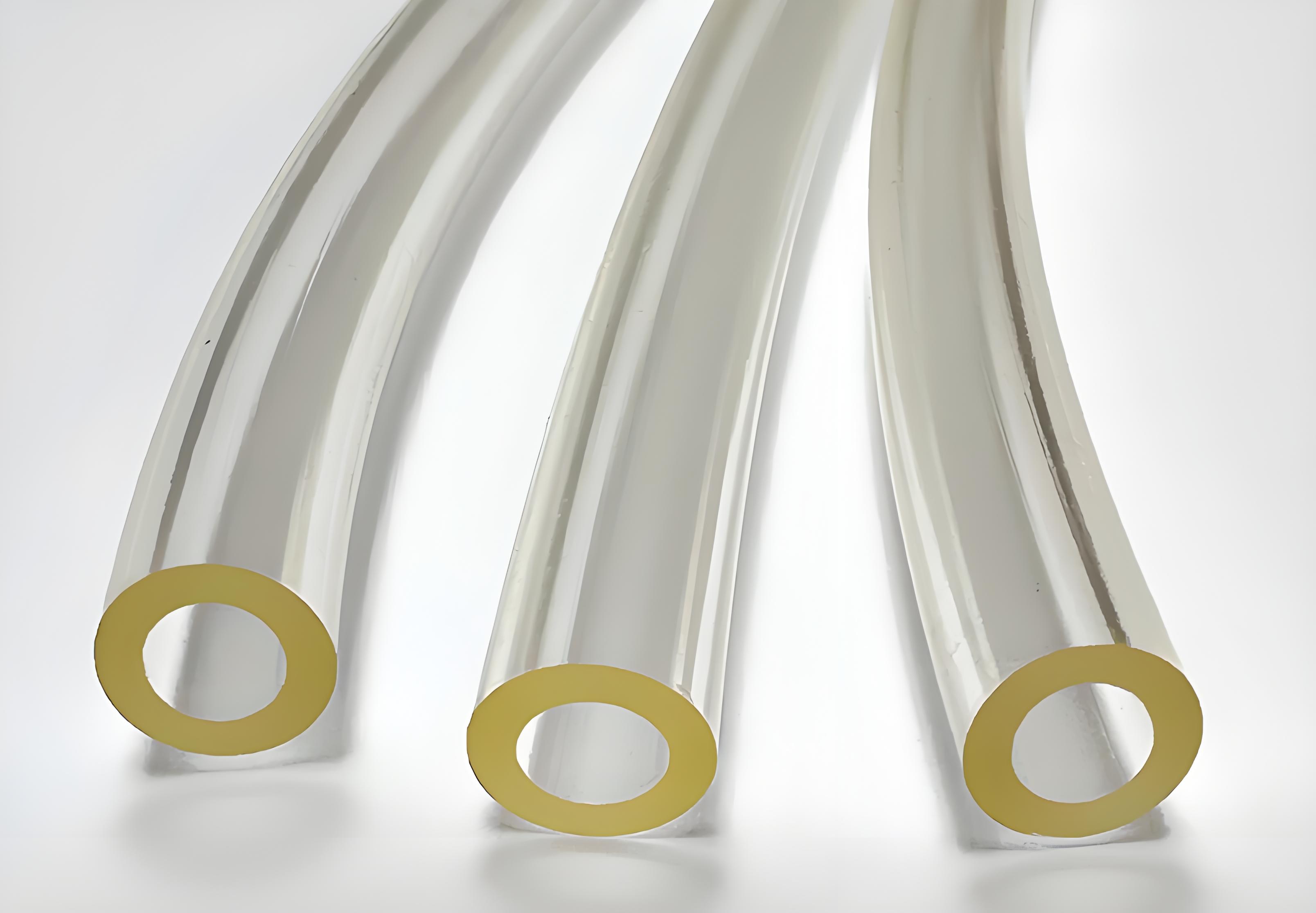
Once the molten TPU exits the die (a ring-shaped tool), it’s immediately pulled into a vacuum sizing tank. Here, water at 15–25°C rapidly cools the tube while a vacuum (0.3–0.5 bar) fixes the outer diameter. This step determines your tube’s roundness and tolerances.
Take, for instance, a medical-grade TPU tube with an outer diameter of 3.2 mm ±0.05 mm—a common spec for IV lines. To hit this tolerance within a 99.7% confidence interval, the line speed must be kept within ±1% using a servo-driven puller. Data from Plastics Technology shows that inconsistent cooling water temperature—a swing of just 5°C—can increase ovality by up to 12%.
Operational Insight: Measure your wall thickness online with a laser or ultrasonic gauge. Use a closed-loop water temperature controller, not just a thermocouple. Moreover, the vacuum pump should have a redundant backup to avoid production stops during long runs.
4. Puller and Cutter: The Need for Consistent Tension
The tube is pulled continuously by two caterpillar belts (often with a rubber coating) at speeds up to 50 meters per minute. Any slip here causes length and diameter variation. Then, cut-to-length machines (either flying knives or rotary cutters) chop the tube into pieces—from 1-meter coil sections to 10-cm medical connectors. On a high-speed line, this happens in milliseconds.
Operational Insight: If you’re producing coiled tubing, always choose a double-headed winder to avoid downtime during spool changes. For precision-length cut tubes, use a shear-cut system rather than saw blades, which produce micro-burrs. Set a servo with fine-tune acceleration—ramping up too fast can stretch the soft TPU and change the Shore hardness.
5. Quality Control: The Air Ring and Beyond
Modern lines often include an online air-leak test. A 2023 industry benchmark from Medical Tubing Manufacturing noted that nearly 1.5% of thin-wall TPU tubes fail pressure tests due to micro-pinholes. To mitigate this, integrated cameras inspect the tube’s surface for black specks (often degraded resin) and gel particles. But don’t stop there—retain a sample from each production hour for tensile and elongation tests.
Operational Insight: A well-calibrated machine vision system can detect pinholes as small as 20 microns, but it’s only as effective as its illumination—use polarized light to suppress glare. In addition, keep extrusion records (temperature, pressure, torque) with a batch number. This allows you to trace a ballooning defect back to the exact motor current spike 4 hours earlier.
6. The Edge: Why Customization Starts Before the Die
It’s easy to think of a production line as rigid, but leading TPU tubing suppliers, like [Shanghai Xingen], build flexibility into their lines. For example, use a multi-layer co-extrusion setup to create a reinforced tube with a stiffer outer layer and a chemical-resistant inner layer. This can increase burst pressure by 220% compared to a single-layer tube of the same thickness.
Operational Insight: When defining your tube spec, always quantify the “end-of-life” requirement—not just burst pressure, but also fatigue life under cyclic bending. Discuss compression set with your supplier; a common TPU (Shore 95A) can regain only 70% of its original thickness after 22 hours at 50% compression at 70°C. If your application involves sustained pressure, switch to a hydrolysis-resistant grade.
Final Thoughts
A modern TPU tubing production line is not a black box; it’s a precise chain of interlinked variables. From moisture removal to cutter blade edge angle—each element holds the power to make or break your product’s performance. Over my years working with extrusion processors, I’ve seen far too many failures caused by overlooking the drying step or assuming that “fast line speed” equals profit.
When you plan your next project, visit the facility and ask about their inline gauging and material traceability. In environments like medical or food handling, a minor QC gap can lead to costly recalls. Choosing a partner who can demonstrate hard data across these six stages will save you time, money, and a headache in validation. And if you seek a partner who embraces these engineered complexities, Shanghai Xingen stands out for its robust process control and transparent testing protocols—qualities that turn TPU pellets into a dependable product.