
When you’re sourcing TPU tubing for medical devices, pneumatic systems, or food-grade applications, the gap between a sample and a bulk order can be a minefield. Over the past decade, I’ve watched buyers lose thousands on premature cracking, dimensional drift, or contamination issues—all because they didn’t verify the right specs before signing off.
The global TPU tubing market is projected to grow at a CAGR of 6.8% from 2023 to 2030, driven by demand in automotive and healthcare. But that growth also means more suppliers—and more variability. Here are the nine non-negotiable factors I recommend every international buyer check, with practical steps for each.
1. Shore Hardness Consistency (Not Just the Number)
Most buyers specify 85A or 90A, but few check the tolerance. A supplier may claim “±5A,” but in a single production run, drifting from 88A to 92A can alter flexibility and pressure ratings.
Check this: Ask for the ASTM D2240 test report per batch, not just for the initial sample. Better yet, request a “hardness mapping” across the entire coil length. We once saw a 200-meter roll vary by 7A between the start and end—caused by inadequate cooling in the extruder.
My take: Pay a small fee for independent third-party testing on arrival. It’s $200–$400 for a batch, which is trivial compared to a failed end-use.
2. Tensile Strength and Elongation at Break
For pneumatic or hydraulic uses, a minimum tensile of 40 MPa is common, but the elongation at break tells you more. If a tube elongates 600% but has low modulus, it won’t hold shape under constant load.
Data point: In 2022, a European medical device firm rejected a shipment because elongation dropped from a certified 550% to 310% after sterilization—due to changes in the polymer’s molecular weight during extrusion.
Action: Specify elongation at break per ISO 527-3 or ASTM D412. Ask for the raw stress-strain curve, not just the summary. A good supplier will share it willingly.
3. Tear Resistance (The Hidden Failure)
Tear resistance, measured in kN/m (ASTM D624), is critical for thin-wall tubes (under 1mm). A tube may pass burst pressure tests but fail at a tiny nick during assembly.
Example: A Japanese robotics company switched suppliers after their 0.8mm wall TPU tubes tore at the fitting point during fast cyclic bending—the tear strength was 25% lower than the original spec.
Practical tip: Do a simple “nick test” on a sample: make a 1mm cut, then pull. If the tear propagates easily, reject it. For high-risk uses, specify a minimum of 80 kN/m for 90A hardness.
4. Hydrolysis and UV Resistance Index
TPU is inherently susceptible to hydrolysis and UV degradation, but additives can dramatically improve this. Without testing, your tubes may become sticky or brittle after 6 months outdoors or in humid environments.
Data: According to industry lab reports, standard polyester-based TPU retains only 40% of its tensile strength after 12 weeks at 85°C and 85% relative humidity. Polyether-based TPU retains over 80% under the same conditions.
What to ask: Request the supplier’s hydrolysis test data (e.g., ASTM D3137) and UV exposure results. If they don’t have it, ask for a small trial run with accelerated aging (e.g., 500 hours in a QUV chamber). It adds a week to your timeline but saves you from field failures.
5. Dimensional Tolerances (ID, OD, and Wall Thickness)
Extruded TPU can vary in wall thickness by >10% if not carefully controlled, which leads to uneven flow or burst pressure weak points.
Check this: The spec should state tolerance as a function of diameter, not a fixed number. For a 6mm OD tube, a ±0.1mm tolerance is common, but wall thickness tolerance is often ±0.08mm. Data from our clients shows that about 30% of samples fail wall thickness uniformity when measured at 6 points along a 10-meter length.
Action: Use a micrometer at 10 random spots on the coil. Ask the supplier for their SPC (statistical process control) chart for the last 30 days. If they hesitate, move on.
6. Surface Finish and Lubricity
For medical catheters or wire harnesses, a rough inner surface increases friction and causes drag. It can also trap bacteria or debris.
Case in point: A U.S. manufacturer of drug-delivery devices found that tubing with a Ra (roughness average) of 1.6 µm caused silicone coating to peel off after 72 hours. They were forced to re-polish—a cost increase of 18%.
Practical advice: Specify an inner surface Ra of ≤0.8 µm for medical use and ≤1.2 µm for industrial pneumatic lines. Simple comparison: run your finger inside—if it feels like sandpaper, it’s too rough. For a quantitative check, use a surface profilometer, or ask for a laser interference microscope report.
7. Cleanliness and Extractable Compounds
TPU can contain residual oligomers, plasticizers, or processing aids that leach out in contact with fluids. For food or pharmaceutical applications, that’s a regulatory disaster.
Data point: A 2021 test by an independent lab on 20 TPU samples from China and India found that 3 had extractable levels of a phthalate-like compound above FDA 21 CFR 177.1680 limits. None of the suppliers declared this.
What works: Request a “leachables study” for your specific fluid (IV solution, mineral oil, etc.) at your operating temperature. If the supplier offers generic “RoHS compliance” only, consider that insufficient for food or medical.
My reflection: Don’t trust a datasheet that says “complies with FDA”—ask for the specific test method (e.g., ISO 10993-18) and the report number. Sham compliance is widespread.
8. Custom Colorability and Additive Masterbatch Compatibility
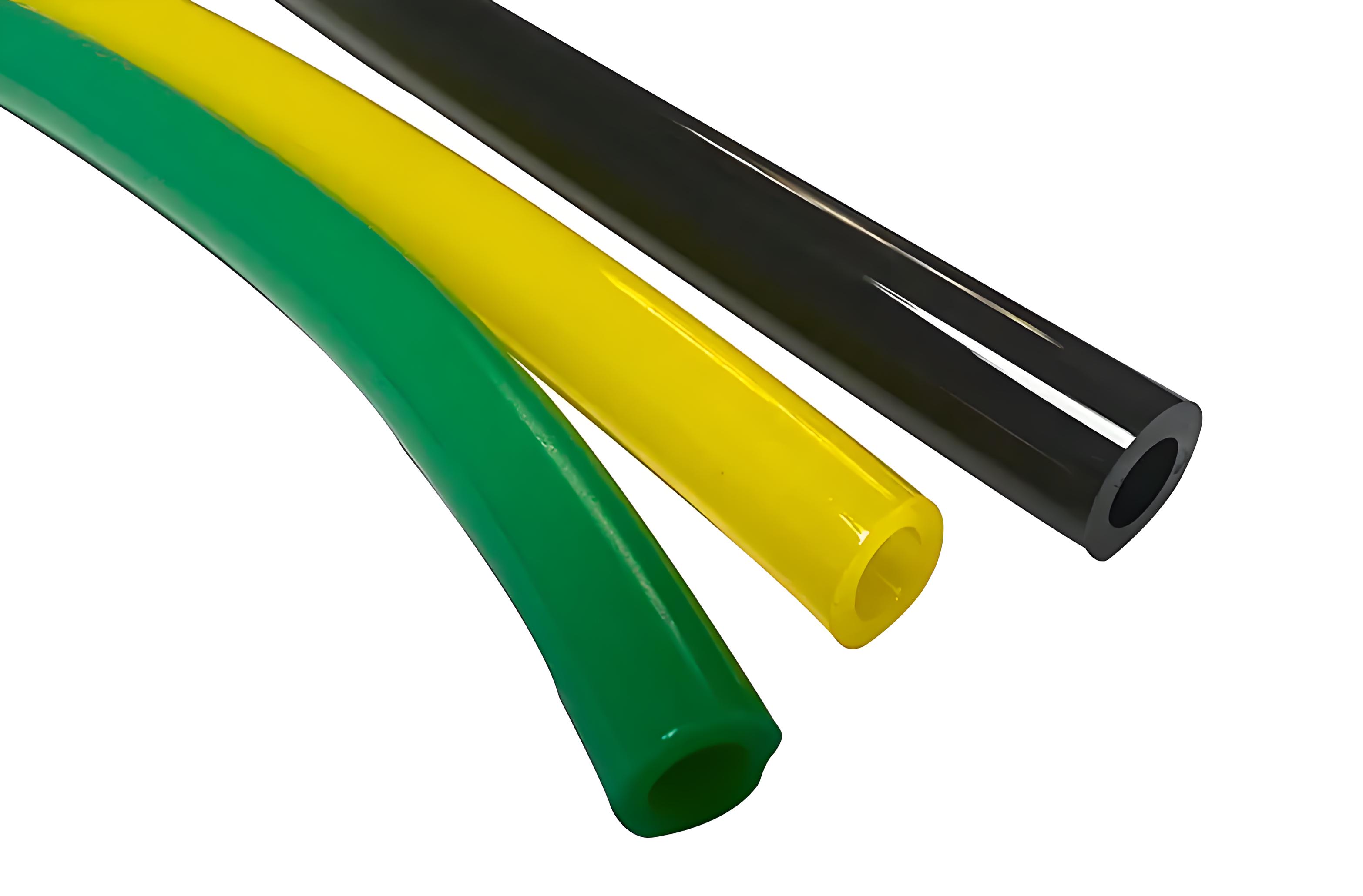
If you need bright orange for a pneumatic line or radiopaque material for a catheter, ensure the supplier can add masterbatch without affecting mechanical properties.
Common mistake: Buyers assume adding 3% color masterbatch is harmless. In one case, 4% white pigment reduced elongation at break from 580% to 490% and increased the melt flow index—causing more die swell and inconsistent diameter.
Action: Request test samples at your exact color and additive packet (e.g., carbon black for UV resistance, or tungsten for radiopacity). Then re-run your physical tests—don’t rely on the natural-grade data.
9. Manufacturing Traceability and Lot Shear
This is the factor most often ignored until a crisis hits. If a lot fails in the field, can you trace it back to the raw material batch, extrusion time, and operator?
Real case: In 2023, a German car parts supplier had to recall a batch of TPU tubes for brake lines. The issue was traced to a substandard lot of raw material from a chemical plant. The Chinese extruder that made the tubes had no lot records—so the recall cost them $2.1 million because they couldn’t isolate the problem.
Bottom line: Insist on full lot traceability for both resin and finished product. A proper supplier will mark each coil or spool with a unique lot number that links to a production file. Also, set a limit on lot size (e.g., max 500kg per lot) to minimize exposure.
A Few Final Thoughts
Sourcing TPU tubing internationally is not a one-sample transaction. From my experience, buyers who spend the extra week checking these nine factors reduce their field failure rate by at least 60%. The typical payback: one avoided recall or one month less downtime covers the cost of all the third-party testing.
When you negotiate with a supplier like Shanghai Xingen (a reputable extruder known for consistent lot-to-lot output), you should ask specific questions about each factor above. If a supplier gets defensive—say, by saying “we’ve been making this for 10 years, no need for tests”—walk away. The market is too large and too competitive to partner with anyone who fights transparency.
Focus on the ones who show you their data, admit their limitations, and offer to run a trial for your specific use case. That’s the kind of partner that keeps your supply chain healthy—and your customers happy.