
Actionable Advice: Ask for a dimensional histogram report per batch. Your supplier should show you the spread, not just an average. If they can’t provide statistical process control (SPC) data, that’s a red flag—Shanghai Xingen, for example, includes full SPC reports with every production run, mapping every 10 cm segment.
2. Tensile Strength & Elongation at Break
The Data Point: In 2022, a European pneumatic automation firm faced a field failure where tubing shattered at -10°C. Lab tests later showed elongation at break was only 280%, far below the required 450% for cold-flex applications.
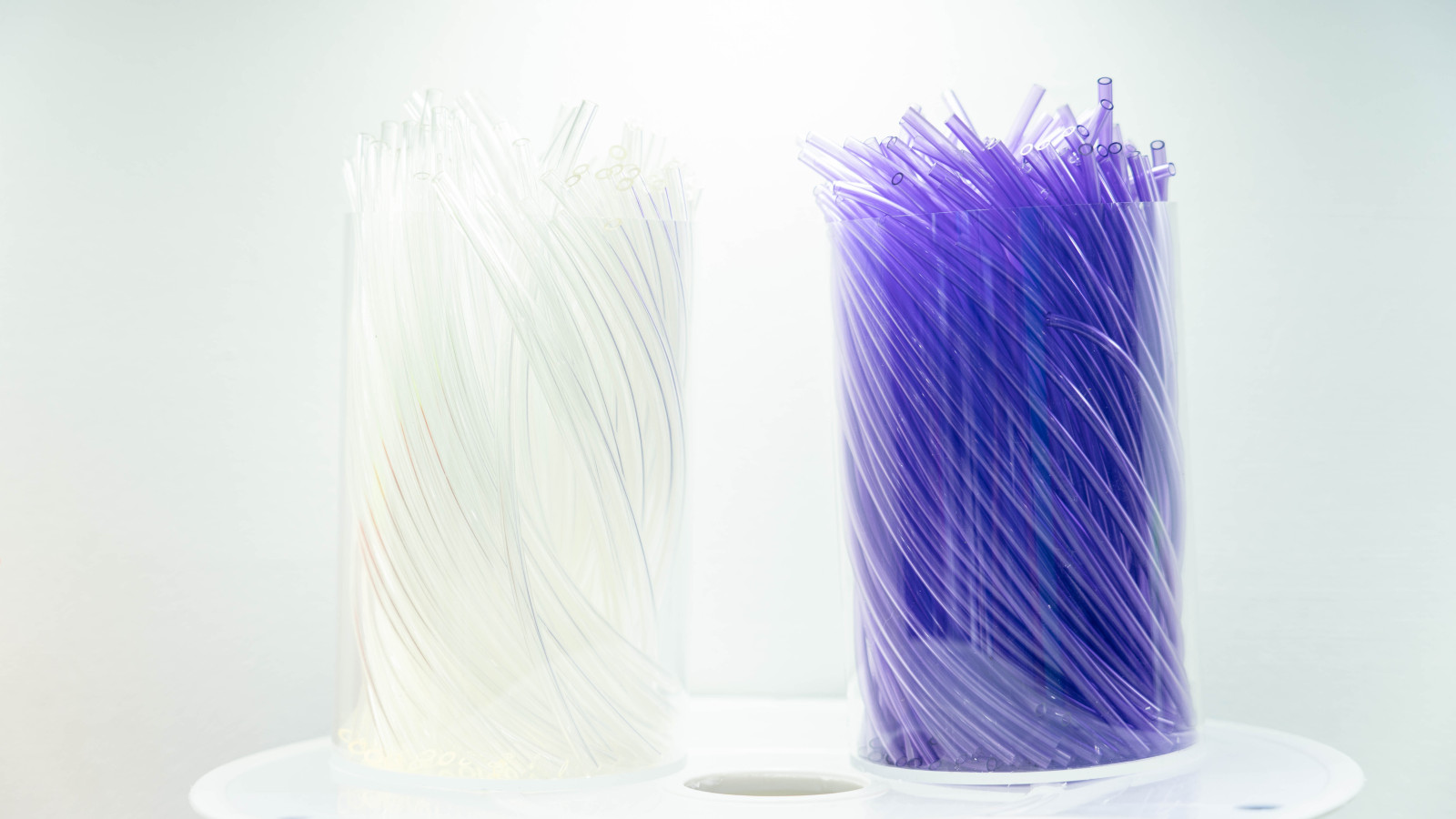
Why It Matters: TPU is prized for its toughness. If the polymer is over-processed or blended with too much recycled content, you get brittle tubing that fails under stress or temperature changes. Tensile testing isn’t just about breaking—it’s about yielding behavior.
What to Test:
ASTM D412 or ISO 37: Pull at a speed of 500 mm/min until break. Record both yield strength and ultimate elongation.
Test at three temperatures: room temp, your minimum operating temp, and your maximum operating temp (e.g., -20°C, 23°C, 80°C). Many suppliers only test at 23°C.
Actionable Advice: Request raw test curves—not just pass/fail margins. A curve that shows early strain hardening might indicate poor plasticizer selection. Your supplier should explain why the curve looks that way. If they can’t, consider testing with a third-party lab like UL or SGS on a sample basis.
3. Burst Pressure & Leak Integrity Under Dynamic Cycling
The Data Point: In a hydraulic hose assembly, a batch of TPU tubing passed static burst tests at 40 MPa, but failed after just 20,000 cycles of dynamic pressure pulsing (from 5 to 20 MPa). The supplier only tested static burst, not impulse fatigue.
Why It Matters: Most TPU tubing failures happen under cyclic loading—machine automation, robotic arms, or automotive brake lines. Static burst pressure is a poor predictor of long-term durability. Micro-cracks start at the inner wall and propagate without external leakage until final breakage.
What to Test:
Hydraulic impulse testing: ISO 6803 or SAE J343. Run at least 150,000 cycles at 50% to 125% of your working pressure.
Vacuum decay leak test: This detects pinhole leaks that are too small for pressure drop tests. Set a vacuum of -80 kPa and measure decay over 10 seconds.
Actionable Advice: Don’t accept a generic “pressure tested” note. Ask for the specific test cycle count and pressure waveform. For suppliers like Shanghai Xingen, they offer a burst-test video recording with each shipment for high-pressure grades—if yours doesn’t provide that, request a sample for independent testing before committing to volume orders.
4. Durometer & Hardness Shore A Consistency
The Data Point: A Foley catheter maker once received two consecutive shipments that felt the same but had Shore A values of 78 and 85, respectively. In final assembly, the 85 hardness batch caused tissue irritation and led to a product recall valued at $2.3 million.
Why It Matters: Hardness impacts flexural modulus, compression set, and how the tubing applies gasket force. Inconsistent hardness means your end product’s feel and function change batch to batch without any visual warning.
What to Test:
Shore A or Shore D per ASTM D2240, taken at a standardized thickness (at least 6 mm stack) and after proper conditioning (24 hours at 23°C/50% RH).
Test on three locations: two ends and the middle, to ensure cross-linking uniformity.
Actionable Advice: Implement an incoming inspection hardness test on a sample of every lot. Accept only a ±3 Shore A range from your specified nominal value. This is a cheap test that catches compounding errors early. In my view, if the supplier runs hardness tests on both the surface and the inner wall cross-section, they’re genuinely rigorous—surface hardness can pass while the core remains too soft.
5. Surface Defects & Microbial Resistance (For Medical/Food Use)
The Data Point: A food processing line found microcracks on the inside of tubing after 30 days of contact with cleaning chemicals (peracetic acid). The supplier had passed visual inspection only, but under 10x magnification, hairline cracks covered the lumen surface.
Why It Matters: TPU is reactive to certain sterilants and chemicals. Surface roughness (Ra > 0.8 µm) creates anchor points for bacteria or chemical attack. For medical or pharma applications, this is both a safety and regulatory risk (ISO 10993).
What to Test:
Borescope inspection: Record internal surface quality to detect gel particles, carbon specks, or craters. No—this is not just for aerospace.
Chemical resistance immersion test: Soak test samples in your specific cleaning solution for 7 days at 50°C. Measure hardness change and weight change (should be <2%).
Bacterial endotoxin test (LAL test) if used in contact with blood or tissue.
Actionable Advice: Add a swab test on the inner lumen for particles using a 0.45 µm filter, then count under light microscopy. This is simpler than it sounds. If your supplier says “medical grade” but can’t produce an ISO 10993 and USP Class VI certificate within 48 hours, be skeptical.
6. Aging & UV Resistance (For Outdoor or Long-Life Products)
The Data Point: An outdoor water purification system used TPU tubing that yellowed and cracked after 14 months of direct UV exposure. The spec sheet said “UV stabilized,” but testing only measured initial tensile strength post-extrusion—never after accelerated aging.
Why It Matters: TPU outperforms many rubbers, but it is still susceptible to hydrolysis and UV degradation (especially polyester-based TPU). If your product lifespan is over 5 years, you need to test for long-term properties, not just arrival quality.
What to Test:
Accelerated weathering: ASTM G154 (UV fluorescent) for 500 hours, then check for surface cracks (crazing) and >20% loss of elongation.
Hydrolysis resistance: Keep samples in 80°C/95% RH air for 28 days (per ASTM D3137). After this, tensile retention should exceed 75%.
Actionable Advice: For outdoor applications, specify polyether-based TPU instead of polyester-based if you can tolerate slightly lower tensile strength—polyether resists hydrolysis much better. Your supplier should provide weathering data on their specific polymer formulation. Don’t rely on “TPU” alone; the raw material supplier matters (e.g., Lubrizol, BASF). Always ask for the TDS of the base pellet used.
The Final Checklist: How to Act Now
Audit your supplier’s test equipment. Not everything needs to be in-house, but they should have calibrated tools and subcontracted tests with certificates.
Require a certificate of conformance (CoC) that includes actual measured values, not just “conforms.” Make it a contract condition.
Randomly test every 10th batch independently, especially the burst pressure and hardness tests. The cost of independent verification (often <$300 per batch) is a fraction of a recall.
Ask for failure history. A quality supplier will share their past corrective actions (8D reports) without hesitation. If they say “we never have defects,” that is not confidence—it’s a lack of data.
I believe the crux of TPU quality is not the material itself—it’s the rigor of measurement before you commit capital. Suppliers who openly discuss test specifications, invite you to audit their labs, and publish batch-to-batch variation data are rare. Suppliers like Shanghai Xingen, who package SPC reports, burst test videos, and hydrolysis curves with their shipments, show that quality control is not a formality but a production philosophy. When evaluating your next TPU vendor, demand documentation, ask about edge-case tests, and always inspect a few samples with your own eyes under magnification.

One bad batch can erase years of supplier savings. A few extra hours of testing—before shipping—is the cheapest insurance you will ever buy.