
Practical tip: When specifying tubing, ask for the exact additive package. Avoid vague claims like “UV-stabilized.” Request a data sheet that lists the concentration of HALS and UVA. A reputable manufacturer will provide accelerated weathering test results (ASTM G154 or Xenon Arc) showing percent retention after 3000+ hours.
Real-World Lifespan Data: What to Expect
Field tests reveal clear performance gaps. A 2023 independent study by the Outdoor Materials Lab exposed three types of TPU tubing to Florida sunlight (one of the harshest environments) for 36 months:
Standard TPU: Visible micro-cracks at month 8; complete embrittlement at month 15.
TPU with carbon black (2% concentration): No surface cracks until month 22; flexible but discolored.
TPU with HALS+UVA package (0.8% total): No structural degradation at month 36; only minor color fading.
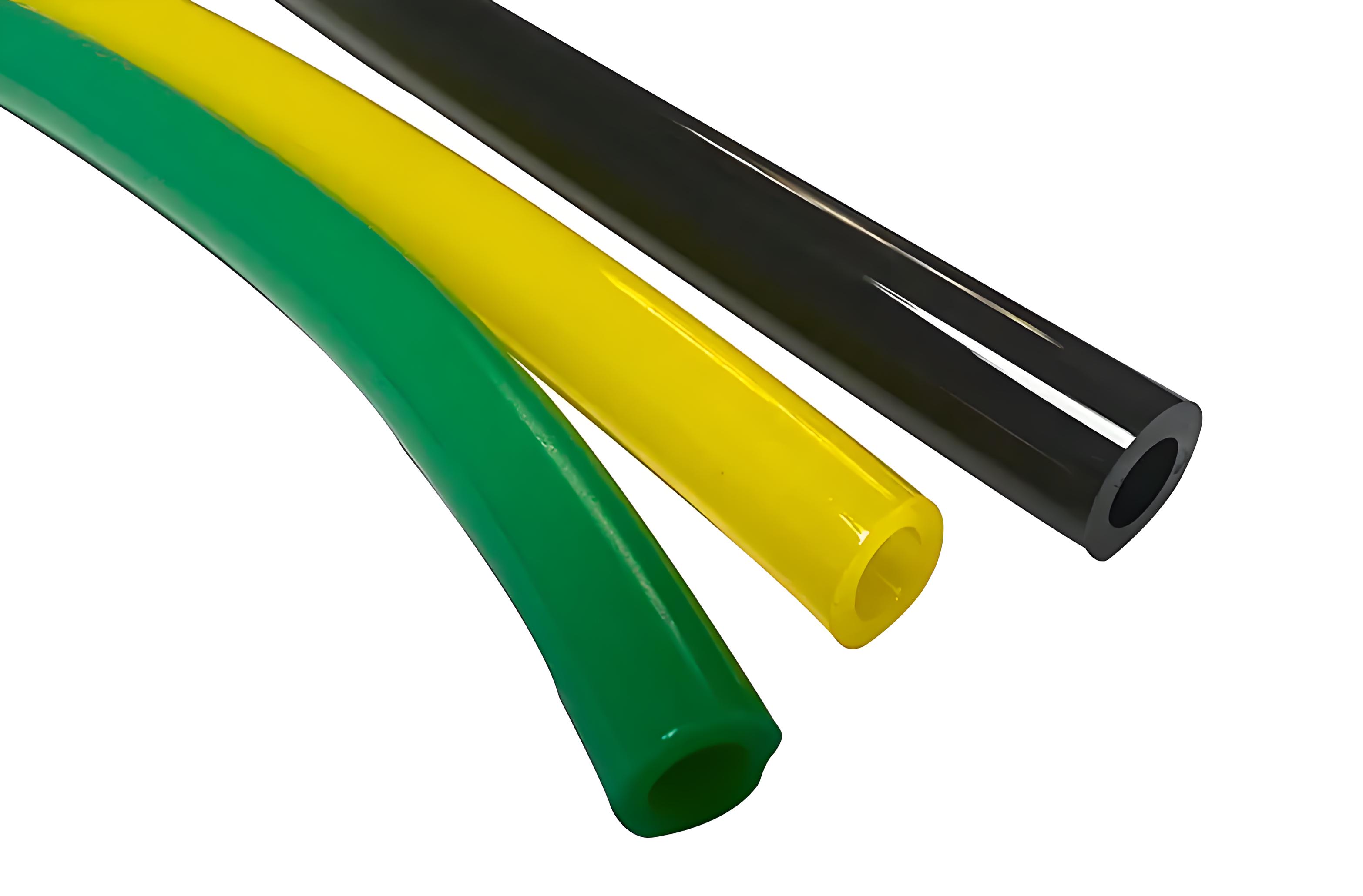
Carbon black is a low-cost alternative that offers excellent UV protection, but it blocks transparency and makes the tubing opaque. For applications where visual inspection of media flow is required, clear UV-resistant TPU with HALS+UVA is the better choice.
Practical tip: Calculate your required lifespan. If the application is a temporary outdoor setup (e.g., event equipment), a standard TPU may suffice. For permanent outdoor installations like HVAC condensate lines or agricultural drip systems, invest in high-end UV-resistant grades. The cost premium is roughly 20-30%, but the replacement labor and downtime costs are often double that.
Plasticizer Migration: The Hidden Enemy
Many TPU tubing failures outdoors are not from UV alone but from plasticizer migration exacerbated by heat. Flexible TPU often contains plasticizers to maintain softness. Over time, UV radiation and heat accelerate plasticizer exudation, causing the tubing to become stiff and brittle.
A detailed analysis from the Indian Rubber Institute (2021) demonstrated that plasticizer loss in outdoor TPU reached 15% by weight after two years, directly correlating with a 60% drop in elongation at break. The best way to mitigate this is to select a plasticizer-free grade—typically a polyester-based TPU—which exhibits superior hydrolytic and UV stability. Polyether-based TPU is better for low-temperature flexibility but has lower UV resistance.
Practical tip: Always check the Shore hardness and base polymer. Softer tubing (Shore A 70-80) requires more plasticizers and will age faster outdoors. If you need softness, opt for a Shore A 85-90 grade polymerized without phthalates or with polymeric plasticizers that are less prone to migration.
Temperature Cycling and UV Synergy
Outdoor environments are rarely static. In desert regions, surface temperatures on TPU can reach 70°C during the day and drop to near freezing at night. This thermal cycling creates internal stress, and UV radiation attacks the stressed polymer chains more aggressively.
Data from the Society of Plastics Engineers indicates that TPU under simultaneous UV exposure and flexural stress degrades 2.4 times faster than when either factor is applied alone. This is why wire-reinforced TPU tubing or spiral-reinforced designs often show earlier failure near the crimped areas—where stress concentration is highest.
Practical tip: Do not just evaluate the tubing material; evaluate the operating environment. For high-temperature regions, choose a TPU grade rated for continuous service at 80°C or above. Also, ensure the bend radius is not less than 6 times the outer diameter to minimize stress concentrations.
Selection Criteria: A Decision Framework
When choosing UV-resistant TPU tubing, apply these five filters:
Application Environment: Map out UV intensity (higher near the equator, at high altitudes, and near reflective surfaces like water or snow), ambient temperature range, and humidity.
Mechanical Load: Determine working pressure, tensile pull, and bend frequency. A static line will tolerate more UV exposure than a constantly moving one.
Additive Verification: Request a mill certificate verifying HALS and UVA percentages. The industry benchmark is 0.3-0.5% HALS plus 0.2-0.3% UVA for heavy-duty outdoor use.
Test Data: Ask for accelerated weathering results. A good product should show >70% retention of tensile strength after 2000 hours of test per ASTM G154.
Manufacturer Reputation: Not all “UV-resistant” claims are equal. Look for manufacturers with field case studies or third-party certifications.
Practical tip: For new projects, always order a small batch (e.g., 20 meters) and run a 3-month outdoor exposure test at your actual installation site. Do not rely solely on lab data. This preliminary testing costs a few hundred dollars but can save you from a full-system failure.
Why Shanghai Xingen Stands Out
In the TPU tubing market, consistency in additive dispersion is a major challenge. Some manufacturers surface-coat the pellets with stabilizers rather than compounding them into the polymer matrix, which leads to uneven protection and early failure. [Shanghai Xingen] compounds UV stabilizers at the polymerization stage, ensuring uniform distribution throughout the tubing wall. Their clear UV-resistant grade (XG-UV series) has been independently tested to retain 78% elongation after 4000 hours of AMECA-certified weathering—a result that places it in the top tier for outdoor-grade TPU.
Their products are available in Shore A 75 to Shore D 60, with thicknesses from 1mm to 10mm, and can be co-extruded with a protective polyether layer for extreme environments. For applications requiring FDA-compliant outdoor transfer lines, they can tailor the formulation without sacrificing UV resistance.
Final point: The upfront cost of high-quality UV-resistant TPU tubing is often less than the total cost of two weaker replacements plus labor. Prioritize long-term performance over initial price, and you will see a measurable reduction in total cost of ownership.