
Real case: A major Chinese medical device manufacturer switched from PE to TPU for their post-surgical tape. Post-market feedback showed a 25% reduction in patient-reported skin irritation and a 15% improvement in patient comfort scores.
Actionable tip: When sourcing TPU for medical tape, ask suppliers for MVTR data and cytotoxicity test reports. Look for grades that meet ISO 10993 standards for biocompatibility.
2. Outstanding Conformability and Fixation Reliability
Medical tape must adhere securely to curved body surfaces—elbows, knees, fingers—without lifting, wrinkling, or causing discomfort. TPU’s elasticity is a game changer.
TPU can stretch up to 300–600% at break while maintaining high tensile strength. This means one strip of tape can conform to complex contours without needing multiple cuts or overlaps.
Unlike PVC, which becomes stiff in cold environments, TPU retains flexibility from -40°C to +120°C. This is critical for tapes used in cold storage transport or for patients with compromised circulation.
Actionable tip: Request low-modulus TPU grades (e.g., Shore A 70–80) for medical tape applications. They provide gentle yet secure hold, reducing the risk of skin tears on frail or elderly patients.
3. Chemical Resistance and Sterilization Compatibility
Medical environments demand materials that can withstand harsh cleaning agents and sterilization methods. TPU outperforms many alternatives here.
Resistance to disinfectants: TPU resists 70% isopropanol, chlorhexidine, and hydrogen peroxide without degradation. A comparative test by a lab in Germany showed that TPU film retained 95% of its tensile strength after 24 hours of exposure to common hospital disinfectants, while PVC lost over 30%.
Sterilization options: TPU can be sterilized via ethylene oxide (EtO), gamma radiation, and e-beam. In contrast, some PE films warp under gamma rays, and non-wovens lose integrity after multiple cycles.
Actionable tip: Verify that your TPU supplier offers gamma-stable formulations if you plan to use radiation sterilization. Ask for SGS or USP Class VI certification as proof of performance.
4. Hypoallergenic and Latex-Free Safety
Latex allergies affect an estimated 1–6% of the general population and up to 10% of healthcare workers (American Latex Allergy Association). Many traditional medical tapes contain natural rubber latex, posing a serious risk.
TPU is inherently latex-free and phthalate-free. It contains no plasticizers that can leach into the skin or wound bed.
Medical-grade TPU films pass OECD 428 skin irritation tests and are classified as non-sensitizing in repeated-insult patch tests.
Actionable tip: In your product labeling, highlight “Latex-Free TPU Backing” as a key selling point. This is especially important for pediatric care, emergency departments, and surgical units.
5. Processing Efficiency and Cost Savings for Manufacturers
TPU backing film is not just a clinical advantage—it’s a manufacturing one. The Shanghai Xin Gen Tech Co., Ltd (Xin Gen Tech) , for example, has optimized its TPU film production to support faster development cycles.
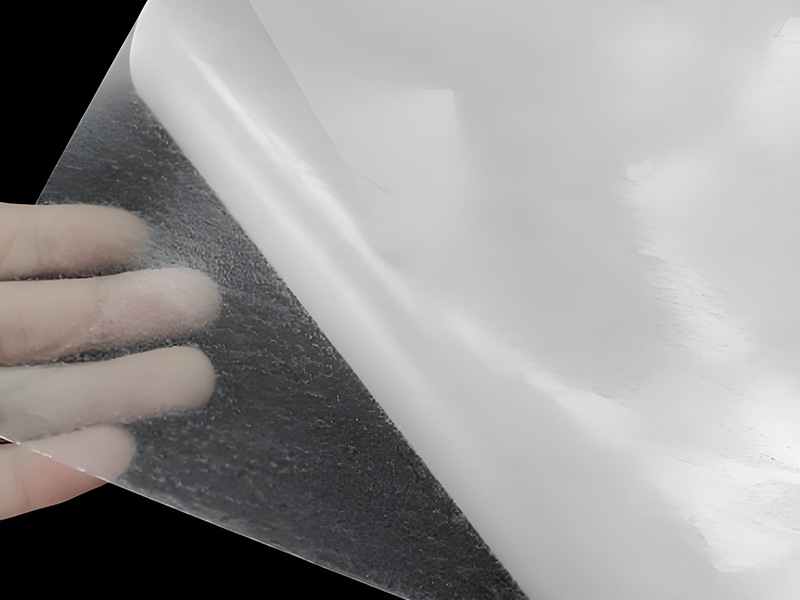
In-house lab with 1:1 production simulation allows sampling at 400mm width with rapid turnaround—70% faster than industry average for custom thicknesses (0.02mm to 0.5mm).
Low minimum order quantities for pilot runs mean you can validate designs without tying up capital.
ISO 9001, OHSAS 18001, OEKO-TEX, SGS, RoHS, REACH, FDA, EU 10/2011 certifications ensure compliance across global markets.
Actionable tip: When evaluating suppliers, ask about lead times for 400mm sample rolls and customization capability—e.g., can they produce a TPU film with specific adhesion levels (5–15 N/25mm) for your tape formulation?
6. Real-World Proof: TPU in Bulletproof Glass Lamination
A BP application might seem unrelated, but the same properties that make TPU excel in high-adhesion lamination for bulletproof glass benefit medical tape manufacturers.
Challenge: A Brazilian customer needed stable adhesion between polycarbonate and glass layers for armored vehicles.
Solution: Xin Gen Tech recommended high-adhesion TPU film with stable optical clarity and peel strength of >20 N/cm.
Result: The product passed lamination testing and entered pilot production. The same adhesion engineering applies to medical tapes that must bond firmly to low-surface-energy substrates like silicone or polypropylene.
7. Market Trends and Future Considerations
The global medical tape market is projected to grow at CAGR of 6.1% from 2024 to 2030 (Grand View Research). As hospitals demand safer, more comfortable, and recyclable products, TPU is positioned to take share from legacy materials.
Sustainability: TPU can be recycled via mechanical methods. Some manufacturers are developing bio-based TPU from renewable sources, which aligns with net-zero goals of many healthcare systems.
Smart medical tapes: Sensors embedded in TPU films for continuous monitoring (e.g., wound pH, temperature) are gaining traction in digital health.
Actionable tip: Partner with a TPU supplier that offers R&D support for next-generation applications, like conductive or transparent TPU grades.
Final Word
Replacing a traditional backing material with TPU is not just a material swap—it’s a strategic upgrade. It improves patient outcomes by reducing irritation and infection risk. It enhances manufacturing efficiency with faster sampling and lower waste. And it future-proofs your product against regulatory and market demands for safer, more sustainable alternatives.
If you’re serious about medical tape performance, start with TPU.